

Twelve years of schooling in Bangladesh is equivalent to seven years of schooling internationally. It is sad and disappointing that we send our children to school with hope. Yet, in reality, they are experiencing a significant loss of learning.
Bangladesh has a very progressive constitutional and policy framework for education. Yet such a loss of learning years reflects a critical gap that remains between the commitments, legal standing, and practice. While policies and frameworks repeatedly promise equity, inclusion, and quality learning, the system in practice continues to reproduce quantity rather than quality, social inequality, class division, and unequal futures. Let’s take a deeper look to understand what exists on paper and where we stand in real practice.
The contradiction begins with the Constitution itself. Article 17 commits the state to establishing a “uniform, mass-oriented and universal” education system, extending free and compulsory education, and eliminating illiteracy. However, education is framed under the Fundamental Principles of State Policy rather than as an enforceable fundamental right. As a result, although the Constitution establishes education as a core state obligation and social necessity, citizens have limited scope to hold the state legally accountable for failing to ensure equitable, high-quality education.
Besides, Article 19 guarantees equality of opportunity and obligates the state to reduce social and economic disparities. Building on these constitutional principles, it took us eighteen years after the adoption of the Constitution to introduce the Primary Education (Compulsory) Act of 1990.
Around twenty years later, the National Education Policy 2010 was introduced with the vision of ensuring education for all, regardless of race, culture, ideology, or disability. It also aimed to develop skilled, knowledgeable human resources capable of meeting future global challenges. However, the reality is still different for many of these promises. We still have a long way to go, and the important question remains: Are we truly moving in the right direction?
Although the Education Policy of 2010 recommended extending free and compulsory education up to Grade VIII, in practice, compulsory education is effectively limited to the primary level, generally up to Grade V. This places Bangladesh behind much of South and Central Asia in terms of educational commitment and continuity. According to UNESCO data, 155 countries worldwide mandate compulsory education from pre-primary through at least lower secondary level. Across the region, countries such as Sri Lanka, India, Nepal, Pakistan, Uzbekistan, and the Maldives have extended compulsory education significantly beyond Bangladesh’s current practice.
The gap becomes even more evident when viewed in light of Bangladesh’s international obligations. As a signatory to the UN Convention on the Rights of the Child (CRC), the Sustainable Development Goals (SDG 4), and UNESCO’s Education 2030 Framework for Action, Bangladesh has committed itself to ensuring inclusive and equitable quality education for all. SDG 4.1 specifically calls for all girls and boys to complete free and quality primary and secondary education by 2030. The country also pledged to allocate between 4% and 6% of GDP to education. Yet public spending on education consistently remains below that benchmark, and when we will be able to provide free education up to secondary school is a big question.
Similarly, Bangladesh joined the global “Education for All” commitments through the 1990 Jomtien Conference and the 2000 Dakar Framework, both of which emphasised universal access, gender equity, and quality learning outcomes. On paper, therefore, Bangladesh appears deeply committed to educational transformation.
Since its independence, Bangladesh has made consistent efforts to reform and adapt the education system. It has formed five education commissions or committees so far for the national education curriculum, framework, and policy. However, despite repeated reforms, commissions, and curriculum restructuring, fundamental questions remain unresolved: Have these reforms meaningfully improved learning outcomes? Have they reduced inequality? Or have they mostly remained administrative and political exercises without deep systemic impact?
Here, one of the biggest structural problems is the existence of three parallel education systems: Bangla-medium, English-medium, and Madrasa education. This has made the administrative structure more complex with many bodies and power centres in education. If proper alignment and coherence aren’t maintained among the different administrations, it would create more complexity in the coming days.
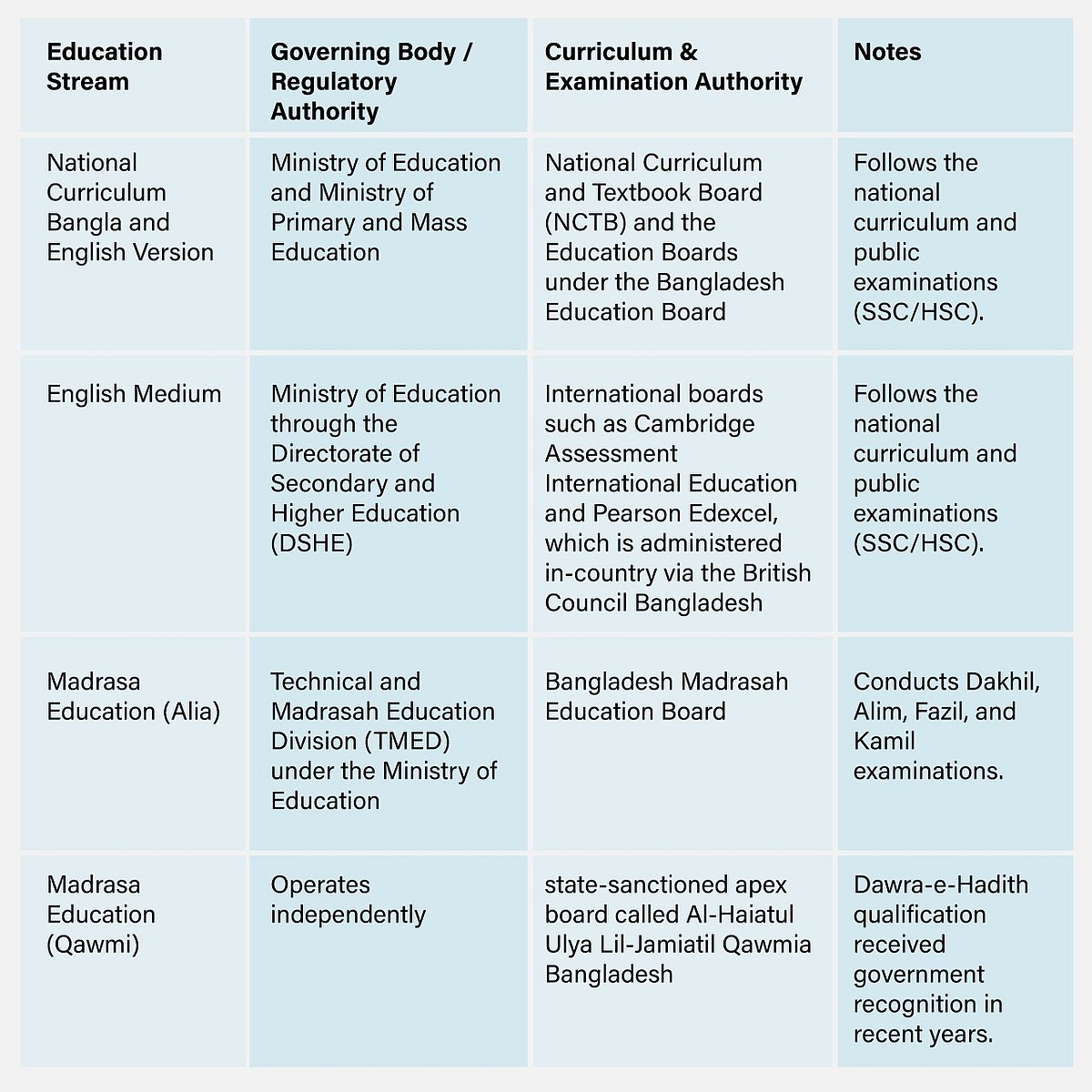
A snapshot of the administrative bodies of different streams (Source: Ministry of Education, Bangladesh, National Curriculum and Textbook Board (NCTB), Education Boards, Bangladesh, Bangladesh Madrasah Education Board)
Besides, these streams do not simply represent different educational approaches; they increasingly reflect social class, cultural identity, and unequal access to opportunity. According to the Bangladesh Education statistics 2024, in Post Primary, around 8.1 million students attend Bangla-medium government/NGO schools within Secondary Education; an additional “English-version” stream uses English textbooks but Bangla board exams. Government schools are free or have low, minimal costs. In contrast, private schools charge a wide range of monthly fees based on the institution and its reputation.
By contrast, pure English-medium schools are tiny (only ~147 private schools nationwide according to Bangladesh Education Statistics 2024) but expanding: enrollment doubled from ~14,500 in 2016 to ~30,000 in 2026. Undoubtedly, these English-medium schools cater to affluent urban families. According to a Business Standard report, based on the institution, fees could be up to Tk70,000/month, and annual costs up to Tk10 lakh. While “Madrasa” education is expanding for the poorer section of society.
According to a recent Daily Star report, Alia madrasas are attracting students because their curriculum now appears closer to general education, while Qawmi madrasas are drawing many poor families because they are cheaper and often provide food, boarding, discipline, and supervision. A report by Bonik Barta from 2024 notes that Alia madrasa enrollment reached its highest level in two decades, rising to around 40.2 lakh in 2022 from around 38.06 lakh in 2019. During the same time, the Qawmi madrasa board recorded an increase of nearly 100,000 students.
This economic disparity and the lower standard of education under the national curriculum have made English-medium and madrasa education more popular nowadays. The rapid rise in the popularity of English-medium education reflects the growing perception that it offers better global opportunities, higher social prestige, and greater economic mobility. Besides, many English-medium schools are now placing greater emphasis on religious education to attract parents. On the other hand, Madrasa education is becoming increasingly popular, particularly among rural, conservative, and economically disadvantaged communities.
As a result, Bangladesh’s education system has evolved into a socially stratified structure:
The wealthy pursue globally competitive education,
The urban middle class navigates national curricula in a few cases with English adaptation,
Marginalised communities often remain confined to under-resourced Government Bangla-medium schools or madrasa institutions.
These divisions extend far beyond language or curriculum. They shape confidence, social networks, mobility, employability, cultural capital, and future economic opportunities. In practice, educational streams increasingly determine life trajectories. Undoubtedly, it is creating a future threat to a more peaceful and cohesive society as it moves toward economically class-based education day by day. Here, the problem is further deepened by the absence of meaningful bridges between systems.
Students moving from madrasa or Bangla-medium backgrounds often struggle to transition into an English-dominated stream. Studies have shown that students from Bangla-medium and Madrasa backgrounds often face critical challenges in universities due to English as a medium of Instruction (EMI), reliance on memorisation over critical thinking, and systematic skills gaps. Another critical challenge is the politicisation of education reform itself. Curriculum and policy changes in Bangladesh often fluctuate with changes in government. Frequent bureaucratic transfers, inconsistent implementation strategies, and limited consultation with teachers weaken continuity and long-term effectiveness.
In many cases, reforms are introduced without sufficient teacher training, classroom preparation, or institutional capacity building. Consequently, curriculum changes frequently remain disconnected from classroom realities. This imbalance has been reflected in the Global Knowledge Index of the last few years. This raises an uncomfortable but necessary question: Is Bangladesh reforming education to transform learning, or merely restructuring systems without addressing deeper inequalities?
*Shahariar Sadat is currently serving as the Executive Director of the Centre for Peace and Justice (CPJ), BRAC University.
Prantick Chowdhury is working as the Lead, BRAC University Access Programme at the Centre for Peace and Justice (CPJ), BRAC University.


