

Govt will move ahead with metro rail projects putting emphasis on cost reduction
A Japanese company will operate the airport's third terminal
Finance minister writes seeking reduction in interest rate on Japanese loans
JICA president is due to visit Bangladesh on a five-day trip
The Bangladesh Nationalist Party (BNP) government is seeking to ease the strains that emerged between Bangladesh and Japan during the tenure of the interim government over several development projects.
As part of this effort, the government has decided to proceed with two Japanese-funded metro rail projects—MRT Lines 1 and 5. It has also decided to handover the operation of the third terminal at Dhaka's Hazrat Shahjalal International Airport to Japan.
Tensions arose during the interim government's tenure over the high bids submitted by Japanese companies for the two new metro rail projects in the capital. The interim government subsequently suspended procedural work on both projects.
The BNP government will now move the projects forward, while continuing negotiations to bring down their costs. To this end, a seven-member technical committee has been formed.
State minister for Road Transport and Bridges, Habibur Rashid, told Prothom Alo that the government’s policy decision is to construct the two metro rail lines with Japanese financing.
However, discussions are continuing with the Japan International Cooperation Agency (JICA), Japan’s development partner, to reduce project costs. The state minister expressed hope that the matter would be resolved.
Japan remains a major development partner, but...
Japan is one of Bangladesh’s largest development partners. According to the Economic Relations Division’s (ERD) 2024–25 report on foreign loans and assistance, Bangladesh’s outstanding external debt stood at US$77.28 billion as of 30 June 2025, with Japan accounting for 18 per cent of the total. Japanese loans are generally provided on concessional terms.
Through the JICA, Japan has recently financed several major projects in Bangladesh, including the metro rail, the Matarbari power plant in Maheshkhali, the third terminal of Hazrat Shahjalal International Airport in Dhaka, and the railway bridge over the Jamuna River. However, concerns have been raised over the high costs of some of these projects.
For example, according to submitted bids, the construction cost of the two new metro rail routes in Dhaka is estimated at Tk 36.18 billion per kilometre. By comparison, the Uttara–Motijheel metro rail line cost Tk 15.74 billion per kilometre.
Dhaka Mass Transit Company Limited (DMTCL) analysed the costs of metro rail projects under implementation in several Asian countries. The analysis found that, excluding land acquisition and salaries, metro rail construction costs in India range between Tk 1.5 billion and Tk 4.5 billion per kilometre.
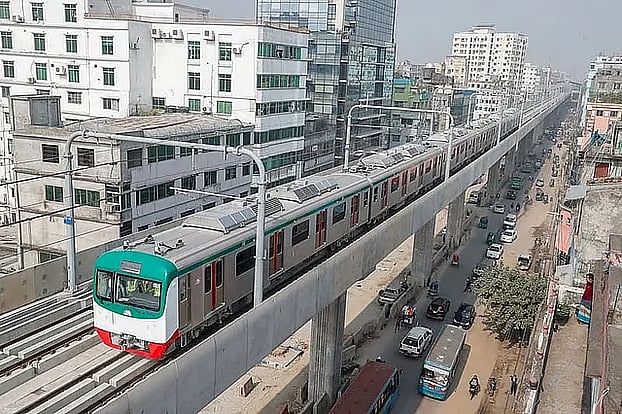
The two new routes are MRT Line-1, which will run from Dhaka airport to Kamalapur and from Notun Bazar to Purbachal, and MRT Line-5, connecting Hemayetpur and Bhatara. Both projects were approved in 2019 during the previous Awami League government, with estimated costs of Tk 525.61 billion and Tk 412.38 billion, respectively.
Following detailed feasibility studies, however, JICA—the project implementation agency—proposed raising the cost of MRT Line-1 to Tk 965 billion and MRT Line-5 to Tk 880 billion. That represents an 84 per cent increase for MRT Line-1 and a 113 per cent increase for MRT Line-5.
The management of DMTCL, appointed during the interim government, objected to the high bid prices. At the time, the company's managing director was Faruque Ahmed, who had experience working on metro rail construction and operations in Australia, India, Saudi Arabia, the United Arab Emirates and Hong Kong.
After DMTCL raised concerns over the project costs, the Ministry of Planning instructed that the metro rail projects be temporarily suspended for further review.
Faruque Ahmed’s contract as managing director of DMTCL was also terminated after the BNP government took office. Sources at the Road Transport Ministry said at least four meetings, both inside and outside the Secretariat, have been held to ease tensions that emerged between Japan and the interim government over the cost of the metro rail projects.
The meetings included one among senior officials from various ministries and divisions involved in implementing the metro rail projects, one between ERD Secretary Shahriar Kader Siddiky and Japanese Ambassador to Bangladesh Saida Shinichi, another between Road Transport and Highways Division Secretary Ziaul Haque and JICA representatives, alongside one between Road Transport and Bridges Minister Sheikh Rabiul Alam and a JICA delegation.
According to ministry sources, the decision was made to move ahead with the projects while continuing discussions with the aim of reducing the estimated construction costs.
Sources at the Finance Ministry and the ERD said policymakers are primarily concerned about why the costs of the two metro rail projects have become so high. At a meeting chaired by Finance Minister Amir Khasru Mahmud Chowdhury on 20 May, the “unusually high” project costs were discussed.
The meeting decided that negotiations to bring down the costs would continue, and that an internationally recognised consultant could be appointed if necessary.
However, a DMTCL source said JICA has argued that a substantial portion of the two new metro rail lines will run underground. As a result, they are more expensive than MRT Line-6 (from Motijheel to Diabari in Uttara). Rising prices of the US dollar and construction materials have also contributed to the increased costs.
Metro rail: Govt to build second one, questions over costDuring the four meetings, JICA cited several examples to justify the higher costs. It said the design of Gabtoli Station, prepared in 2019, now requires revision. The station's planned length has been increased from 300 metres to 650 metres. The depth of both Bhatara and Kachukhet stations has also been increased, while labour costs have risen as well.
On the other hand, Bangladesh has argued that the conditions attached to Japanese loans are structured in a way that leaves little room for contractors from other countries to participate in the bidding process. Under the loan conditions, consultants must be appointed from Japan. These consultants prepare the tender documents in a manner that, more often than not, favours Japanese contractors.
Although the metro rail tenders are formally open to all bidders, in practice only two or three companies repeatedly take part in the process. As a result, opportunities for other international firms to compete remain limited.
On 23 May, the ERD secretary met Japan’s ambassador to Bangladesh to discuss the two metro rail projects.
Speaking to Prothom Alo, ERD Secretary Shahriar Kader Siddiky said discussions with Japan on the construction of the two metro lines were progressing positively. At the same time, however, the costs of both projects were being reviewed.
Meanwhile, Emeritus Professor of Civil Engineering of the University of Asia Pacific M Shamimuzzaman Bosunia has been appointed convenor of a seven-member technical committee tasked with assessing whether the proposed cost increases for MRT Line-1 and MRT Line-5 are justified.
Other members of the committee are Professor Syed Ishtiaque Ahmed of the Department of Civil Engineering at the Bangladesh University of Engineering and Technology (BUET), Professor ABM Toufiq Hasan of the Department of Mechanical Engineering, Professor Ziaur Rahman Khan of the Department of Electrical and Electronic Engineering, Muhammad Shakhir Ahmad Chowdhury, director (joint secretary) at the Implementation Monitoring and Evaluation Division (IMED) of the Planning Ministry, independent local consultant Harun Rashid, and financial expert Shafiqul Alam.
The Road Transport and Highways Division announced the formation of the committee in an office order issued on 24 May.
Speaking to Prothom Alo, committee convenor Shamimuzzaman Bosunia said the panel would examine why the costs of the two metro rail projects had increased and determine whether the higher estimates were justified.
Third terminal agreement expected soon
The long-running negotiations and disagreements over awarding the ground handling contract for the third terminal at Dhaka's Hazrat Shahjalal International Airport to a Japanese company, as well as revenue-sharing arrangements, have now been resolved following the BNP government's assumption of office. The contract will be awarded indeed to the Japanese company.

The third terminal project, costing more than Tk 210 billion, was launched in 2017. Of the total cost, the government contributed Tk 50 billion, while Japan financed the remainder through loans.
After the BNP government took office, Prime Minister Tarique Rahman on 22 February instructed the relevant authorities to expedite the launch of the third terminal. A decision was subsequently made to entrust its operation to a Japanese firm.
Civil Aviation and Tourism Minister Afroza Khanom told Prothom Alo on Tuesday that efforts were under way to sign an agreement between the Civil Aviation Authority of Bangladesh (CAAB) and the Japanese consortium—a four-company alliance—within this month to operate the third terminal.
Under the revenue-sharing arrangement, Japan will receive 73 per cent of the revenue, while Bangladesh will receive 27 per cent, she added.
The Japanese consortium comprises Japan Airport Terminal Co., Sumitomo Corporation, Nippon Koei and Narita International Airport Corporation.
Letter to Japan asking for lower loan interest rates
Meanwhile, Japan has raised interest rates on loans extended to Bangladesh and other countries. The new rates came into effect on 1 April this year.
According to sources at the Economic Relations Division, the fixed interest rate on standard Japanese loans stood at 2.9 per cent in October last year. From 1 April, it increased to 3.6 per cent—an increase of 0.7 percentage points.
Japan is one of Bangladesh's largest sources of external financing. As a result, Bangladesh will now have to pay higher interest on future loans from the country.
However, Bangladesh's Finance Minister Amir Khasru Mahmud Chowdhury has written to his Japanese counterpart, requesting that the interest rate be restored to its previous level or kept on concessional terms.
The letter, sent through the Japanese Embassy in Dhaka late last month, noted the long-standing relationship between Bangladesh and Japan and highlighted Japan's immense contribution to Bangladesh's development.
The letter also stated that Bangladesh has asked the United Nations to postpone its graduation from the list of least developed countries (LDCs) by three years due to the ongoing global economic crisis. It added that the country has received support for extending the LDC graduation preparation period until 24 November 2029.
In the letter, the finance minister requested that Japan maintain the previous, more favourable interest rate—or otherwise keep the loan terms concessional—for the next three years.
Metro Rail: Construction cost per kilometre set to double'Efforts to reduce project costs must continue'
Wednesday marks the 10th anniversary of the militant attack on the Holey Artisan Bakery in Dhaka. To commemorate the seven Japanese nationals killed in the attack, JICA President Akihiko Tanaka is visiting Dhaka for five days to attend a memorial event.
During his visit, he is scheduled to meet several senior government ministers. Sources said the meetings will focus on Bangladesh-Japan relations and ongoing development projects.
Speaking to Prothom Alo, Zahid Hussain, former lead economist at the World Bank’s Dhaka office, said there was no question about the competence or expertise of Japanese companies.
However, concerns have been raised over the costs of some projects they have implemented or are currently implementing in Bangladesh. The reasons behind those costs, and where responsibility lies, are still not entirely clear, he added.
Zahid Hussain further said maintaining a strong relation with Japan is important for Bangladesh from both geopolitical and economic perspectives. “But efforts to reduce project costs must continue,” he remarked.


