

A new work from the Subodh series by the anonymous artist HOBEKI? appeared on 30 June 2026 on the north-west wing wall of Majitar Nala Bridge, Gangtok-Rangpo Road, Rangpo, Majitar, Sikkim, India. The graffiti, executed in a distinctive stenciling technique and using spray paint on a concrete wall, measures approximately 20 x 12 ft and carries the artist’s name tag, HOBEKI?, on the right side. According to ARTCON, the work remains visible and has been confirmed through HOBEKI?’s Instagram page, as well as ARTCON’s ongoing documentation of the artist’s practice.
The location is not accidental. Rangpo is widely known as a gateway town to Sikkim, situated near the West Bengal border and along the Teesta-Rangpo river corridor. It is one of the key entry points into Sikkim on the route toward Gangtok, where movement, arrival, documentation, and permission are already part of everyday life. That geography turns the graffiti into more than an image. It becomes a border event.
The work shows Subodh, HOBEKI?’s iconic bearded figure, in a strikingly altered posture. He is bare-bodied, with messy hair and tattered jeans, lying in a hammock. But the hammock is tied with barbed wire. In his right hand, Subodh holds up a wire cutter. His left arm hangs down toward a water bucket placed on the ground. At first glance, the scene appears relaxed, almost like a traveller resting after a long journey. But each object quietly complicates that calm.
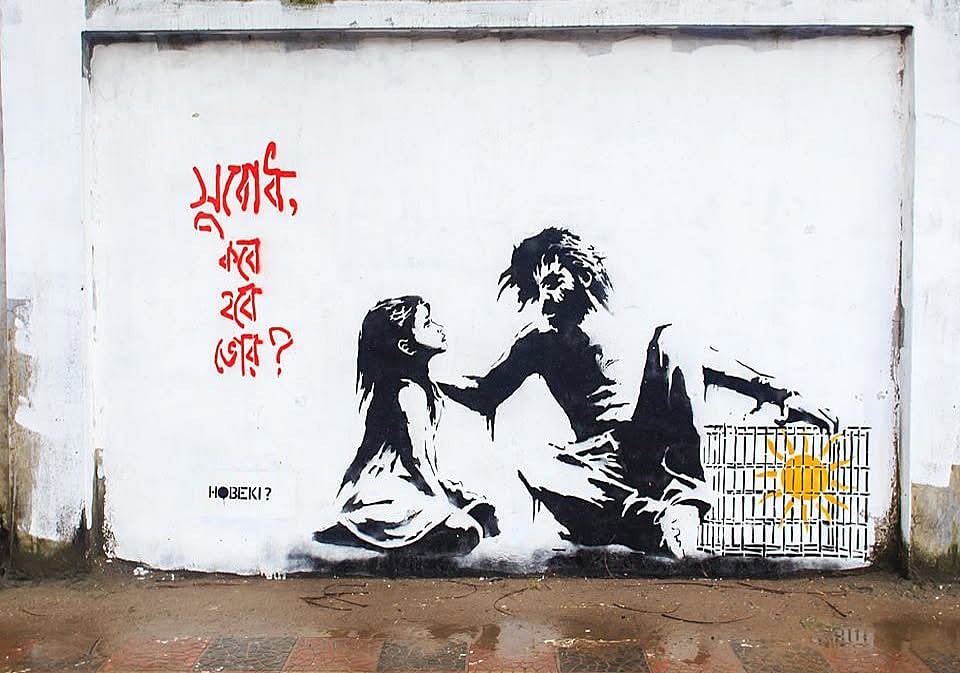
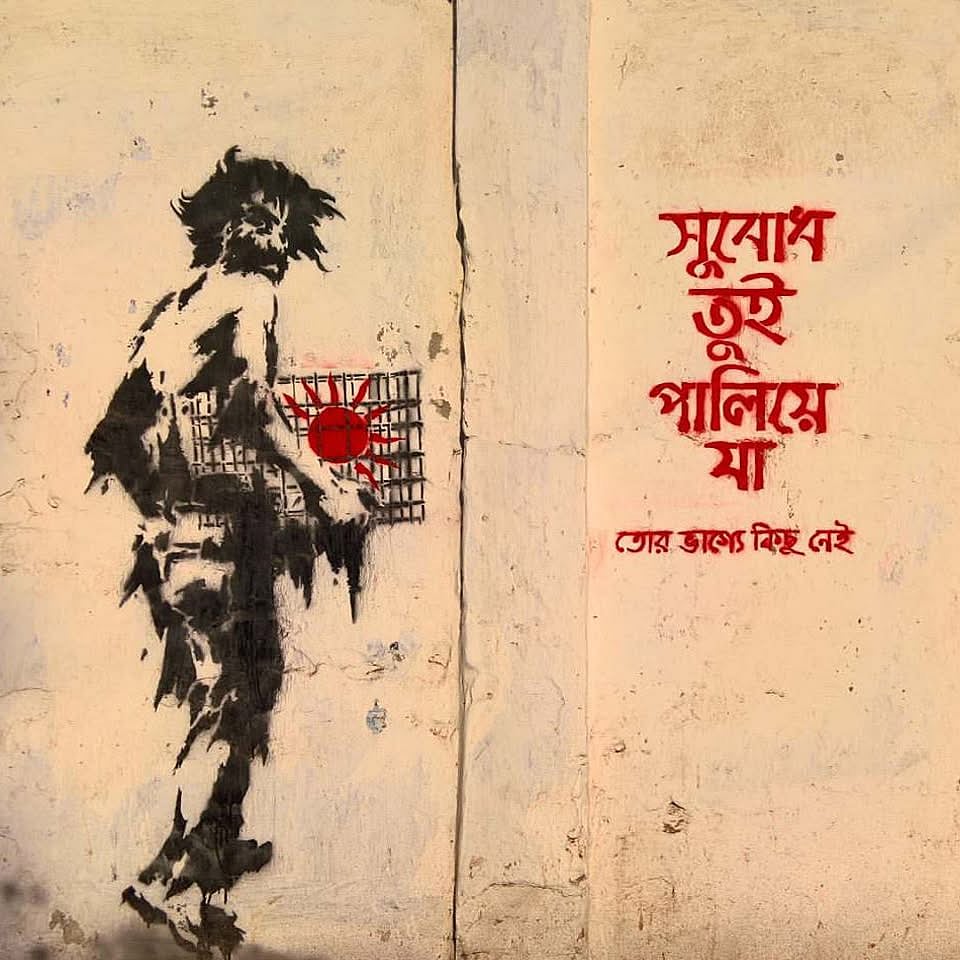
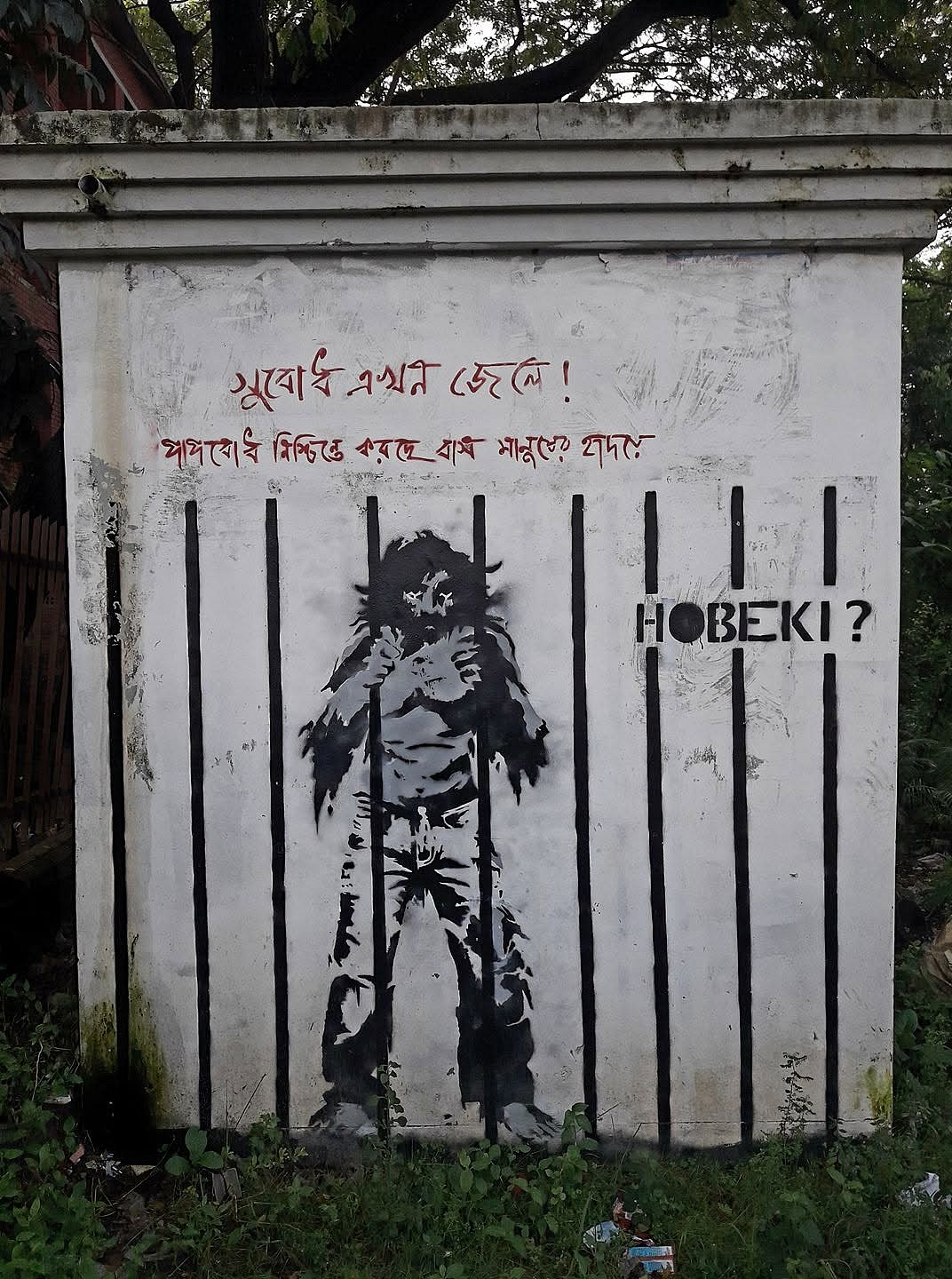
For years, Subodh has been one of the most recognizable figures in Bangladesh’s contemporary street-art imagination. Earlier Subodh series as stencil and spray-paint works showing a gaunt young man in tattered jeans, often running with a cage containing a bright sun. These works were accompanied by messages urging him to flee, as if time, luck, and society itself had turned against him. The series has been read as socially ambivalent, politically ambiguous, and closely tied to anxieties around migration, censorship, despair, and public conscience.
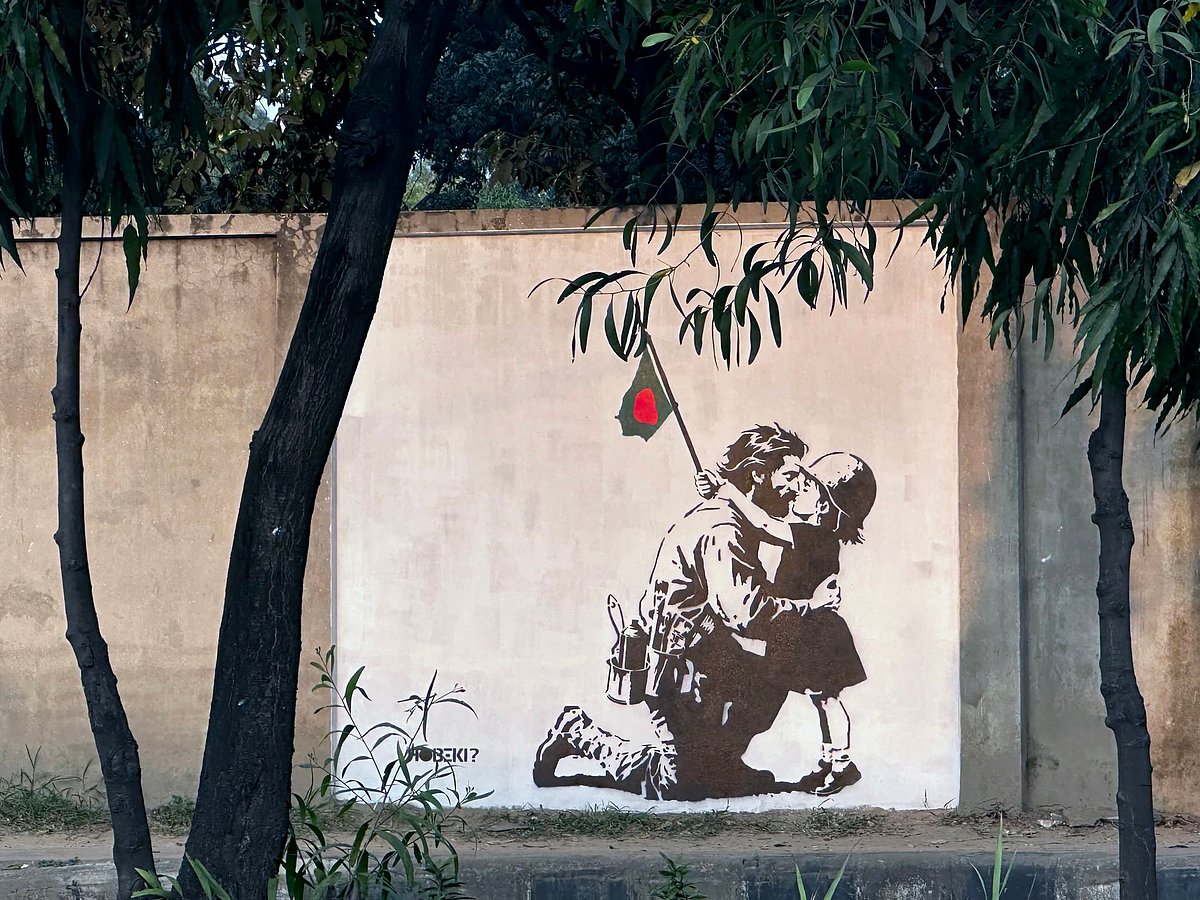
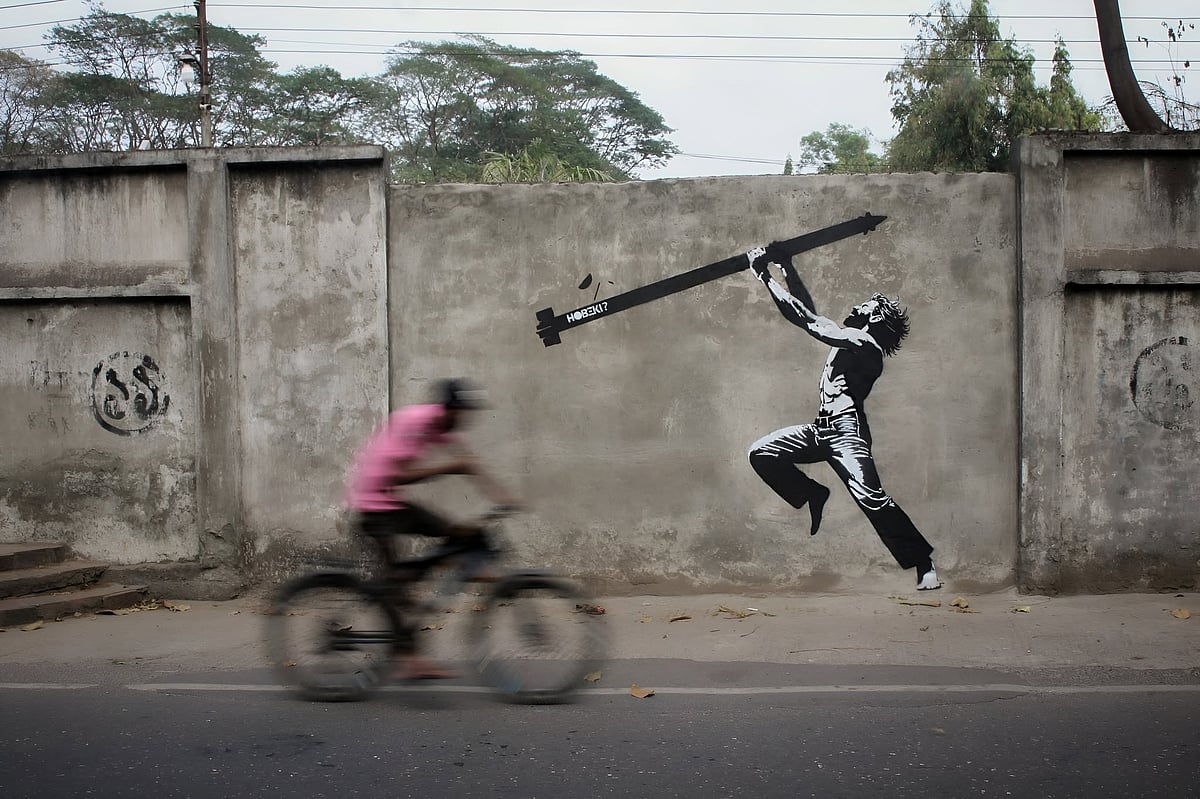
More recently, Subodh reappeared on 7 March 2026 on a wall in the Old Airport area of Agargaon, Dhaka, in the second work of HOBEKI?’s Stop War series. In the image, Subodh was shown stopping a missile with his bare hands, extending the figure’s earlier visual language of flight and vulnerability into a more direct anti-war gesture. Yet even this return proved unstable. Later that month, the Subodh mural on the old airport boundary wall was reportedly removed when a section of the wall near Gate No. 11 of the National Parade Square was demolished. Fans described the incident as a painful erasure of public art, while others suggested that it may have resulted from routine preparations for national events. The episode left the work suspended between erasure, administrative neglect, and the fragile afterlife of street art in Dhaka.
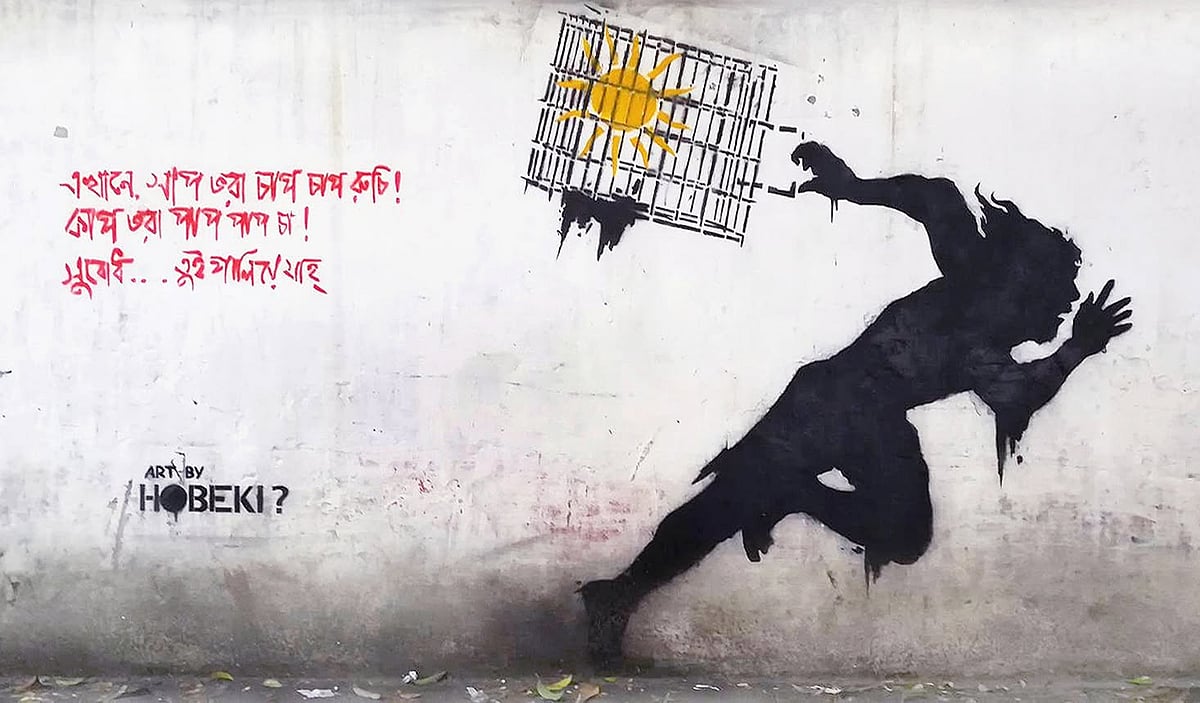
The new Majitar work changes that emotional direction. Earlier Subodh often appeared as a figure in motion, pushed by fear, urgency, or collapse. This Subodh does not flee. He has arrived.
He lies across the border not as a refugee of fear, but as a symbolic traveller. He is not escaping in panic. He is resting with strange confidence, as though he has already crossed the line that others must still negotiate through paperwork, policy, and permission. The work’s emotional register is therefore different from many earlier Subodh appearances. It gathers freedom, border crossing, hope, diplomacy, people-to-people connection, protest, and trespass into one deceptively simple image.
The timing gives the artwork its strongest political charge. India resumed tourist visa applications for Bangladeshi citizens from 28 June 2026, nearly two years after tourist visa services were suspended following Bangladesh’s 2024 political changeover. Applications for Indian visas through five visa centres in Bangladesh were reported to have reopened as part of a gradual normalization of services and an effort to strengthen people-to-people ties between the two countries. Two days later, Subodh appears in India.
In a poetic twist, he seems to become Bangladesh’s first symbolic tourist to India after the reopening of tourist visas. This should not be read as a literal travel claim, but as an artistic provocation. Subodh does not stand in a visa queue. He does not carry a passport. He does not wait for a stamp. Instead, he appears already across the border, lying on a barbed-wire hammock with a wire cutter in hand. That is where the controversy lives, without needing to shout.
The barbed-wire hammock is one of the most powerful symbols in the work. A hammock usually suggests leisure, rest, tourism, and freedom of movement. Barbed wire suggests division, danger, territorial control, and restricted passage. By combining the two, HOBEKI? compresses a central contradiction of travel in South Asia: the dream of movement and the reality of borders. Subodh turns the border into a resting place, almost mocking the idea that human connection must be permanently interrupted by wire.
The wire cutter deepens that reading. It is not shown as a weapon against a person. It is a tool against obstruction. It symbolizes the removal of barriers that stand between people and people. It suggests a desire to cut through fear, suspicion, administrative delay, and inherited distance. The tone is not hostile. It is sharper than diplomacy, but still diplomatic. It does not accuse any government directly. It simply asks whether people can meet again.
The water bucket placed near Subodh’s hanging hand adds a quieter, more regional layer. Because the work appears near the Teesta River, the bucket may be read as a possible allusion to water, sharing, scarcity, and the unresolved emotional geography of Bangladesh-India relations. It does not state the issue directly. It lets the viewer notice the river, the container, and the silence between them. In a less restrained artwork, this could have become propaganda. Here, it remains symbolic, which is precisely why it works.
The bridge wall is equally important. A bridge is not only an engineering structure. It is a promise between two sides. By choosing the wing wall of Majitar Nala Bridge, the artwork places Subodh literally on a structure of connection. The bridge becomes both site and metaphor: Bangladesh and India, departure and arrival, memory and future, restriction and passage.
Subodh’s arrival in India also reopens a longer artistic history. The Telegraph India reported in 2017 that Subodh had inspired appearances in Calcutta, including university spaces, though those were understood as adapted or locally produced versions rather than confirmed HOBEKI? works. That earlier history makes careful wording important. The Majitar work is best described as the first known confirmed HOBEKI? Subodh appearance in India, and as Subodh’s first symbolic post-visa-reopening journey across the border.
This distinction matters because the artwork’s force depends on credibility. Its significance is not merely that an image of Subodh exists in India. Its significance is that HOBEKI?’s Subodh appears at a gateway town, beside a bridge, near a shared river, immediately after the reopening of tourist visa applications for Bangladeshis. The artwork turns a policy development into a visual fable.
Subodh is the expression of freedom. This time, he does not wish to flee. He arrives, heals, protests, trespasses, and travels freely. He does not need a visa, passport, or permission in the symbolic world of art. The hammock suggests the right to travel and rest anywhere, while the wire cutter becomes a tool for removing the obstacles that divide people from one another.
This reading keeps the work within a diplomatic and artistic frame. India is not presented as an enemy. Bangladesh is not presented as a victim. Instead, India becomes destination, mirror, neighbour, and witness. Bangladesh becomes origin, memory, and emotional pressure. Between them is Subodh, the restless figure who once ran with a caged sun, now lying in a hammock made from the very material that usually keeps people apart.
The image is hopeful, but not naïve. It acknowledges strained relations, closed routes, delayed movement, and human waiting. It remembers that borders do not affect everyone equally. Some cross easily. Some wait. Some are stopped. Some remain stuck between systems. Recent reporting from the Bangladesh-India border has shown the human cost of unresolved border situations, including families stranded in no-man’s land after failed flag meetings between border forces.
Against that reality, Subodh’s relaxed pose becomes both dream and protest. He is what ordinary people often cannot be: weightless before bureaucracy, calm before wire, free before permission.
At the same time, the work avoids simple nationalism. Its emotional direction is not anti-India or anti-Bangladesh. It is anti-distance. It asks whether two neighbouring peoples can recover cultural intimacy after a difficult political period. It asks whether art can cross before policy fully settles. It asks whether a figure born on the walls of Dhaka can rest on a wall in Sikkim and still belong to both sides.
The answer is left open, as HOBEKI?’s signature always suggests: Will it happen?
In the new Majitar graffiti, Subodh does not carry the caged sun. Perhaps the sun is no longer the burden. Perhaps the border is. Or perhaps the sun has moved from the cage into the possibility of travel itself. The work does not explain this. It simply gives us a man, a hammock, barbed wire, a cutter, a water bucket, a bridge, and a river nearby. That is enough.
Subodh has crossed the border. Not as a diplomat. Not as a tourist in the ordinary sense. Not as a fugitive. He has crossed as art crosses: without permission, without passport, and with a question large enough for two countries.
ARK Reepon
Founder, ARTCON
Image credit: Courtesy of ARTCON. Media may publish freely with credit.


