

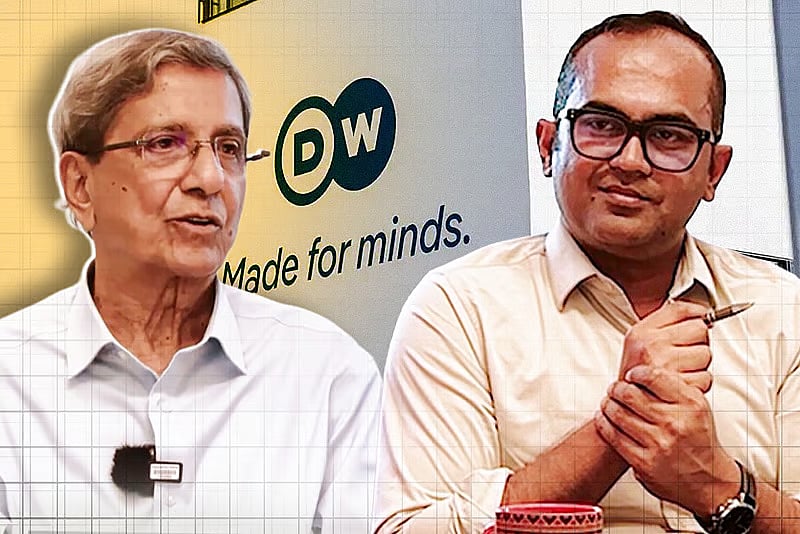
During a recent visit to Germany to attend the DW Global Media Forum 2026, Prothom Alo Editor Matiur Rahman sat down with Deutsche Welle's Zobaer Ahmed for an in-depth interview. In this wide-ranging conversation, he spoke on the recent changes in Bangladesh's political scenario, the state of Bangladesh's media landscape, press freedom, challenges and threats faced by Prothom Alo, the future of journalism, and much more. This is the concluding installment of a two-part interview.
Zobaer Ahmed: We are talking about media freedom and journalists’ safety in Bangladesh. How safe are journalists in reality? If a journalist in Kurigram faces a lawsuit or is attacked, or someone in Teknaf faces such a situation, how do the establishments they work for actually support and protect them? We have journalist unions and a government structure, yet we keep seeing repeated attacks on journalists. Where is the actual protection mechanism? At what level does protection really exist?
I would not place the responsibility primarily on the government. I would rather emphasise the responsibility of institutions.
In the context of Prothom Alo, whenever one of our journalists faces harassment for any reason, or faces a lawsuit, or is in danger, or is at risk of imprisonment or goes to jail, we provide full legal and financial support. That is our responsibility, and we fully take it on. In cases involving journalists from other newspapers, we also try to take a strong public position in their support.
In the past, we have generally not seen the state step forward in such cases. The government tends to intervene or provide assistance only when the journalist is of its own political camp. They may even arrange special funds or assistance in such cases. But if the journalist belongs to another party or media outlet, they do not do the same.
If a newspaper can't survive, it becomes difficult to defend human rights, democracy and social justiceWe have seen attacks on journalists in every regime, and cases are filed against them in various ways, often to intimidate them. Can a legal framework be created so that whenever a journalist is attacked, there is an automatic system of protection? Could newspapers, editors, journalist organisations, and other bodies together create such a legal framework?
Your question is very important. I will go back to a point I made earlier. Our state, society, and media are all affected by deep political divisions. Because of this fragmentation, it has not been possible to take unified collective action or establish a coordinated system.
However, we did support an initiative during the previous interim government when a media commission was formed. In its report, it not only recommended the formation of a media commission but also suggested introducing a journalist protection law. We supported that then, and we still support it now. In fact, just last week, at a discussion organised by the information ministry about the future of the Media Commission, in the presence of ministers we again expressed our support for a journalist protection law. Such a law can only be effective if the government takes the initiative. I hope that under the current government there will be some progress in this regard.
They feel that instead of spending money on media advertising, they can run a newspaper of their own. If they own a newspaper, others will fear them and not write against them, because they can also respond in return
Zobaer Ahmed: After July 2024, we saw many journalists broadly implicated in cases, several currently facing charges. There are also murder cases. Names like Shakil Ahmed, Farzana Rupa, Mozammel Babu, and Shyamal Dutta have appeared in reports. Many journalists have been in prolonged detention, and although cases exist, there has been no trial process. Around 266 journalists have reportedly been accused in various murder cases. Are these cases proceeding on the basis of law, or on perception?
I will return again to the same point. Our country, society, state, and politics are all deeply divided. During the previous government, we can say that a section or group of journalists directly sided with the government, took position against opposing views, and made various provocative statements. As a result, a perception was created that they played a favourable role in government actions and events. That is part of journalistic freedom.
The perception is that they supported an authoritarian, corrupt, and people-alienated government that oppressed citizens. However, we, that is, Prothom Alo, The Daily Star, the Editors’ Council, and the newspaper owners’ association (NOAB), have repeatedly raised questions about their trial, punishment, and imprisonment. Recently, on behalf of the Editors’ Council, we raised this issue in discussions with Prime Minister Tarique Rahman.
Eventually, he requested a list. Mahfuz Anam was assigned to prepare that list. He prepared it and submitted it to the prime minister. The authorities said they would look into it, investigate, and inform us of what could be done. Our position is that these cases should be reconsidered. Not everyone is guilty. In murder cases, these allegations have not been proven, nor accepted as fact. But they have been placed in a kind of retaliatory cycle.
In my view, the government has taken a slow approach. It is allowing things to continue and is unlikely to take any sudden decisions. What is unfortunate is that some individuals are being charged under other cases, such as ICT cases, which is another issue.
Their argument is that even if someone was not directly involved in a crime, they created an environment that enabled it, and therefore they are responsible. This raises major questions of journalism, law, ethics, and politics. But we believe that such false cases, murder cases without basis, and cases without evidence cannot stand. They are not sustainable under any legal system. Keeping these cases pending does not serve the government well.
We reported daily on deaths, the number of dead, their identities, where and how they died. So far, no one has been able to challenge those reports. Every day we published updates on how many people were killed, where they were killed, and how.
Zobaer Ahmed: We see that various wealthy businesspeople with economic and political interests owning newspapers. How much influence does that still have on editorial policy today, and how do you deal with it?
The truth is this: throughout the history of journalism in Bangladesh, major newspapers have more or less been backed by wealthy individuals. That has always been the case. Take Ittefaq, for example, founded by Manik Mia. Over time, it also became a major commercial enterprise. Similarly, owners of newspapers like The Observer or Purbodesh were established and wealthy individuals.
After independence, the expansion of newspapers was also driven by wealthy groups for business, protective, or political interests. Newspapers of different sizes were created for different purposes. Over time, it has reached a point where almost every major business group feels: if I do not own a newspaper, where is my protection?
It is also true that one group writes against another, and another writes against someone else. They feel that instead of spending money on media advertising, they can run a newspaper of their own. If they own a newspaper, others will fear them and not write against them, because they can also respond in return.
In our case, the ownership of Prothom Alo is under Mediastar Limited, largely controlled by the Transcom Group. Our newspaper was founded on three conditions: first, it would be an independent and impartial paper; second, it would sustain itself financially; and third, it would operate independently. We have never published news in favour of the Transcom Group or its business interests, nor have we ever been asked to do so. They have never demanded it either. That is why our newspaper has gained popularity, readership, and influence across print, online, digital, and social media platforms. Today we are considered the number one newspaper.
Zobaer Ahmed: How does politicisation happen? One aspect is ownership, as you mentioned. Another issue is that sometimes media outlets don’t even realise they are being used politically. Many people allege that the media tends to appease those in power rather than question them.
This is probably a situation that exists, to some extent, in all countries when it comes to the press, and it exists in ours as well. But I would also say that the facts do not really support the idea that we try to appease those in power. In fact, we have had very difficult times, whether during the BNP government from 2001 to 2006 or under the Awami League government up to 2024. As I mentioned earlier, under every government we have faced attacks. So I do not think that characterisation applies to us.
However, yes, what you are saying does happen in some cases, whether intentionally or unintentionally. Media outlets are influenced, directed, or guided by governments, and they act accordingly. That may continue in the future as well.
Zobaer Ahmed: Let me move to another topic. There has been allegations that Prothom Alo was sympathetic to the “Minus Two Formula” under the 2006 caretaker government. What would you say?
What happened in 2007 was a military intervention by the Bangladesh Armed Forces. In the situation that developed in late 2006 and early 2007, I would say no section of society was completely uninvolved. Awami League openly supported it and was there in its swearing in. Sheikh Hasina publicly said that her party would accept all decisions, reforms, and measures of that government in Parliament.
BNP, on the other hand, took a different position and did not participate in those events. But the country became deeply divided over the issue. There was extreme political uncertainty, instability, and fragmentation, and from that situation, people moved toward change.
There was also a sense among the public, shaped by the events of the previous 20 years, that such questions needed to be addressed. In that context, various individuals, political parties, leaders, and groups became involved in the process.
But coming to your main point, yes, ideally newspapers should remain outside political positions and maintain independent journalism. In our country, some newspapers may have faced challenges in maintaining that neutrality. None of us have ever been completely outside politics or society; the situation itself made that very difficult.
Zobaer Ahmed: Let me ask another question. How do you think minority groups, whether religious, cultural, or ethnic, are covered in the media? Do you think they receive the coverage they deserve, and is it done in the right way?
We try to give due coverage and bring these issues forward. If we look at Bangladesh’s history, from the partition in 1947, and especially after 1971, we see that communal tensions and extremist tendencies have affected politics. Attacks on minority communities, particularly Hindus, have not disappeared under any government; they have continued in varying degrees.
There have also been attacks on Buddhist communities. It is not correct to say that such incidents did not occur during the Awami League government or that it was less. They did occur. So there is a division in our society, along with the influence of extremism and religious groups. We need to be more alert and proactive.
Zobaer Ahmed: If we talk about the newspaper market, what is the situation like in Bangladesh now? How many printed copies does Prothom Alo publish these days?
The global trend is that print readership is declining. Online platforms are growing, social media is growing, and video content is expanding.
We are trying to protect print, strengthen online, maintain a strong presence on social media, and expand video content. We were somewhat behind in video because during Awami League era we avoided it, as showing or saying certain things might create problems for us.
So yes, print circulation has decreased, including ours. But if you look at print, online, digital, and video together, we are in a very strong position. Around 97 per cent of readers are connected with Prothom Alo across print and online platforms.
Zobaer Ahmed: How difficult is it now to sustain a traditional newspaper as a business? And at the same time, you now have multiple verticals, print, digital, and even large events, etc. How does that work?
We run two magazines that are very successful and profitable. We also organise roundtables and seminars. We earn revenue through events. We have been diversifying for the past 15 years, in order to reach the people, talk to them, and engage in discussion.
Now in digital as well, it is not just advertising. We run various kinds of digital businesses and events. As a result, while print is declining, digital is generating income. Across print, digital, online, video, magazines, publications, and books, we have achieved significant diversification. We are trying to generate revenue in different ways.
We are also moving toward an e-paper subscription model. But honestly, in our country, it is not easy to survive only by selling newspapers. We have to find new ways of earning. That is the way forward.
Zobaer Ahmed: In this age of social media, news has become influencer-driven. Influencers are producing content that people are increasingly drawn to, and we see this a lot in Bangladesh.
After the July-August 2024 movement, some well-known commentators and voices overseas had influence at that time, but that influence has waned. That influence had been directly behind the attack on our office. They even called on people that night, urging them to go and attack. But that influence is now declining.
At the end of the day, there is truth and there is falsehood. People ultimately want to know and see the truth.
Zobaer Ahmed: There is also fake news. You see various media cards circulating using newspaper names, but in reality those stories were never really published. So how can traditional media survive while dealing with fake news and the influence of social media influencers?
That is exactly the battle we are in. We try our best never to publish incorrect news. We have dedicated fact-checkers in our office who monitor things 24 hours a day, along with several other people.
We have to adapt with time. Recently, we have even hired separate staff for Gen Z audiences. We must keep trying new approaches. We cannot afford to stand still.
Zobaer Ahmed: A final short question: Prothom Alo has been around nearly 28 years. Can you mention two points of time, one when you felt most successful, and one that was the biggest challenge for you?
If I mention one success, I would say the July-August 2024 period. It was one of the biggest challenges in Prothom Alo’s history. At that time, our editorial team would stay in the office for around 14 hours a day. We were extremely careful to ensure no incorrect information was published.
We reported daily on deaths, the number of dead, their identities, where and how they died. So far, no one has been able to challenge those reports. Every day we published updates on how many people were killed, where they were killed, and how. Not a single day passed when the information ministry, the home ministry, or intelligence agencies did not call me or my senior colleagues. And we would simply say, we are not publishing anything false. Some ministers would say, “We understand, we see what is happening, but we cannot do anything. Everything is being decided by one person.”
That period, I believe, was the best time in our journalism. We did our best work as a newspaper, and readers trusted and followed us closely. That was one of the strongest phases for us.
But at the same time, I also remember the period of March-April 2024, when there was uncertainty about whether Prothom Alo would continue, and whether I would remain editor.
So, the best times and the most difficult times were all packed into March, April, May, June, July, and August 2024.
Zobaer Ahmed: Thank you very much for joining us. You gave us a lot of time and shared many valuable insights.
Thank you as well. I haven’t given an interview in a long time, so it was good to speak. Wishing you all the best.
* This interview was taken in Bengali and has been transcribed and translated into English by Ayesha Kabir


